
Every good CPA tries to lower your taxable income. That is great in April when you owe the IRS less money. It is terrible in June when you walk into a local bank to buy another rental property and the loan officer tells you that you don’t make enough money on paper to qualify.
Most real estate investors hit this wall after buying two or three properties. Conventional banks obsess over W-2 paystubs, personal debt-to-income ratios, and two years of tax returns. If you write off depreciation, mileage, and repairs, your tax return makes you look broke even when your properties bring in solid cash every month.
That exact headache is why so many landlords start researching what is a dscr loan and how does it work before making their next offer.
According to housing market data from CoreLogic, real estate investors consistently account for roughly 25% to 28% of single-family and small multifamily purchases across the country. A huge chunk of those buyers aren’t using standard bank mortgages anymore. They are using cash-flow loans that judge the building, not the borrower’s day job.
Here is the plain-English breakdown of how these loans work, how the math shakes out, and what lenders actually require.
First Things First: What Does DSCR Loan Stand For?
If you are new to commercial or investor financing, the acronyms get old fast. So what does DSCR loan stand for?
It stands for Debt Service Coverage Ratio.
And what is DSCR in real estate? It is a simple number that tells a lender whether a property’s rental income is big enough to pay its own mortgage and operating bills.
To really understand what is a DSCR loan and how does it works, you have to look at how traditional banks underwrite loans versus how investor-focused lenders do it. A standard bank asks if your salary can cover the new mortgage plus your house payment, car notes, and credit cards. A DSCR loan skips your personal income entirely. No W-2s. No IRS Form 1040s. No explaining to an underwriter why your business had a slow quarter two years ago.
If the rent from the property covers the loan payment, the deal has legs.
The Math Behind the Scenes
When borrowers ask me what is a DSCR loan and how does it work on the numbers side, I show them a basic division problem. There is no complicated Wall Street formula here.
For 1-to-4 unit residential rentals, lenders usually calculate it like this:
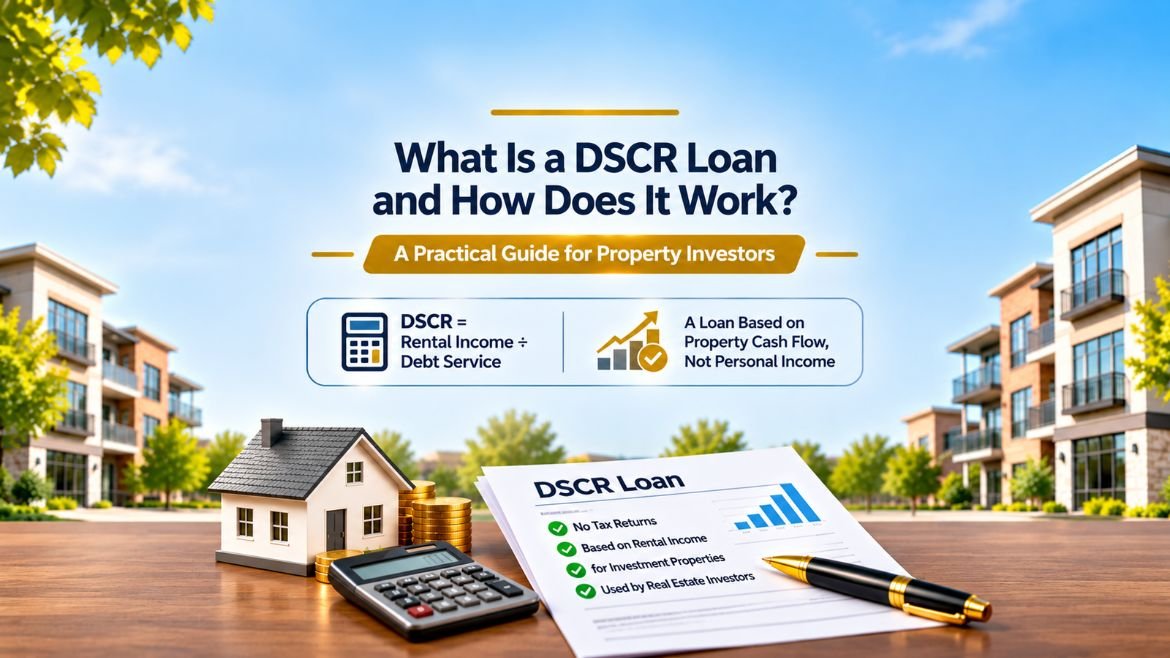
DSCR = Gross Monthly Rent ÷ Monthly PITIA
(PITIA means Principal, Interest, Taxes, Insurance, and Association dues)
For larger commercial buildings (5+ units, retail, warehouses, or mixed-use), lenders take out operating expenses first:
DSCR = Net Operating Income (NOI) ÷ Annual Debt Service
A ratio of 1.0 means the property breaks even. Every dollar of rent goes straight to the expenses and mortgage, leaving nothing left over. Most lenders don’t like breaking even. They want a cushion in case the water heater blows up, or a tenant takes an extra month to move in.
Here is how three different properties look on an underwriter’s desk:
| Property Scenario | Monthly Rent / NOI | Monthly Loan Cost | DSCR Score | How Lenders React |
| Scenario A (Strong) | $5,000 | $3,850 | 1.30x | Easy approval, best interest rates, lower down payment options. |
| Scenario B (Tight) | $4,000 | $3,850 | 1.04x | Approved by some lenders, but expect a slightly higher rate or 25% down. |
| Scenario C (Shortfall) | $3,200 | $3,850 | 0.83x | Declined by banks. Only specific “no-ratio” private programs will touch it, usually at 30%+ down. |
Most programs want to see a 1.20x to 1.25x ratio. That means the building brings in 20% to 25% more cash than the loan costs.
What Is a DSCR Lender and What Do They Check?
People hear “no tax returns” and assume there are no rules at all. Not true.
So what is a DSCR lender actually looking at when they open your file? Instead of digging through your personal paychecks, they put the property and your balance sheet under a microscope.
That brings us back to what is a DSCR loan and how does it work during actual underwriting. Expect the lender to verify four main things:
- The Appraised Rent Schedule: You can’t just make up a rent number to make the math work. If the building has tenants, the lender checks the signed leases. If it is vacant, the appraiser fills out a market rent schedule (like Form 1007 on smaller rentals) based on what comparable units nearby actually rent for.
- Your Credit Score: Yes, your credit still counts. Most programs start around a 640 or 660 FICO score, while the best rates go to borrowers sitting above 720.
- Down Payment: Expect to put down 20% to 25% on a purchase. If you are doing a cash-out refinance, most lenders cap the loan-to-value (LTV) around 70% to 75%.
- Cash Reserves: Lenders want to see 3 to 6 months of mortgage payments sitting in your bank account after you pay the down payment and closing costs.
If you are building a portfolio of single-family homes, townhomes, or apartment buildings, using specialized rental property loans built around DSCR rules lets you scale past the 10-property limit that Fannie Mae puts on conventional borrowers.
Recourse vs. Non-Recourse on DSCR Deals
One detail investors often overlook is whether the loan requires a personal guarantee.
Most small-balance DSCR loans are full recourse. Even though you close the loan inside an LLC, you still sign a personal guarantee saying you will cover the shortfall if the property goes into foreclosure.
However, larger commercial DSCR deals can sometimes be structured as non-recourse, meaning the lender can only take the building if things go bad—leaving your personal bank accounts and home untouched (aside from standard “bad boy” carve-outs like fraud). If protecting your personal net worth is priority number one, always ask upfront whether the quote you are looking at is recourse or non-recourse.
Pros and Cons Nobody Mentions Upfront
Once you grasp what is a DSCR loan and how does it work, the trade-offs become pretty obvious. These loans solve a major problem, but they aren’t free money.
Why investors love them:
- You don’t hand over tax returns, W-2s, or CPA letters.
- You can close the property directly in an LLC or corporation name.
- Closings usually take 2 to 4 weeks instead of 60 days.
- There is no hard cap on how many properties you can finance at once.
What you need to watch out for:
- Slightly higher rates: Expect interest rates to run roughly 0.75% to 2% higher than a standard owner-occupied home mortgage.
- Prepayment penalties: Almost every DSCR loan comes with a prepayment penalty, often a 3-year or 5-year step-down (like 5-4-3-2-1). If you plan to flip the building in eight months, a long-term DSCR loan with a heavy prepayment penalty is the wrong tool.
For buyers picking up multi-unit buildings or commercial assets that need flexible structuring, comparing different investment property loans side by side helps you avoid locking yourself into a prepayment penalty that clashes with your exit plan.
Getting Funded With Marques Commercial Capital
Every lender writes their DSCR rules a little differently. One lender wants a 1.25x ratio and a 700 credit score. Another will go down to a 1.0x ratio on a short-term rental if you put 25% down. Calling ten different shops to figure out who likes your property type wastes time you could be spending finding your next deal.
Still wondering what is a DSCR loan and how does it works for the specific building you have under contract? That is where Marques Commercial Capital steps in.
We work with real estate investors, landlords, and business owners nationwide to match properties with lenders who actually want to fund them. Instead of forcing your deal into a rigid bank box, our team looks at the rent roll, the equity, and your timeline—then shops the file across our network of portfolio lenders, private debt funds, and institutional capital partners.
Whether you are buying a 4-unit rental, refinancing a 20-unit apartment building, or looking at broader commercial real estate loans, Marques Commercial Capital helps you structure the debt cleanly and get to the closing table without the runaround.
Reach out to our team today to run the numbers on your next property.
Frequently Asked Questions
1. In simple terms, what is a DSCR loan and how does it work?
It is a real estate investor loan where approval is based on the property’s rental income rather than the borrower’s personal income or tax returns. If the rent covers the monthly loan payment at the lender’s required ratio, the property qualifies.
2. Can I live in a property financed with a DSCR loan?
No. DSCR loans are strictly for business-purpose investment properties. You cannot use one to buy your primary residence or a vacation home for personal use.
3. What is a good DSCR ratio for a rental property?
Most lenders look for a ratio of 1.20x to 1.25x or higher. Some lenders offer programs down to 1.0x (break-even), though you will usually pay a slightly higher interest rate or bring a larger down payment.
4. Can first-time real estate investors get a DSCR loan?
Yes. While some lenders prefer borrowers who have owned at least one rental property in the last three years, several programs allow first-time investors if their credit score is solid (usually 680+) and they have strong cash reserves.
5. Do DSCR loans work for Airbnb and short-term rentals?
Many DSCR lenders do finance short-term rentals. Instead of a long-term lease, they usually verify income using 12 months of booking history from platforms like Airbnb or VRBO, or projections from data tools like AirDNA.